Cabinet Noir>History / Alberti cipher
Not sure which cipher? Identify itHistory
Alberti cipherHistory of the Alberti cipher
The Renaissance man with a disk
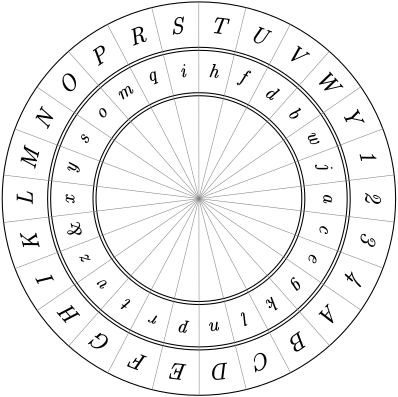
Leon Battista Alberti (1404–1472) was an architect, artist, musician and mathematician — the model "Renaissance man" — and in 1467 he presented the Pope with a writing device he called Formula: two concentric bronze discs on a common pin. The larger one, Stabilis, holds a capital-letter alphabet; the smaller one, Mobilis, a mixed lowercase alphabet. Turn the inner disc and every letter changes its meaning.
The first polyalphabetic system
Before Alberti, every cipher known to Europe used one fixed alphabet — and the Arab cryptographers had already shown how to break such ciphers by letter counting. Alberti's disk answers that attack directly: turn the disc and the frequency table of your message no longer applies. The twenty letters of the outer ring were shared across Europe at the time (I, J and U were not yet separate letters, K and W were rarely used), and the digits 1–4 on the ring encoded a second layer: a codebook of 336 phrases that could be superenciphered with the numbers.
A book, not a machine
Alberti wrote the system down in De Cifris (1467), the first printed book on cryptography. The Latin West slowly absorbed the idea: Johannes Trithemius published the tabula recta — a table of all alphabets laid out in a square — a generation later, and Giovan Battista Bellaso turned the alphabets with an easy-to-remember key phrase. That regularised descendant, misattributed to Blaise de Vigenère, outlived them all — this site covers it under the Vigenère cipher.
Why the disk still matters
The disk itself was superseded, but its two ideas never left cryptography: change the alphabet during the message, and mix the target alphabet instead of merely shifting it. Every rotor machine up to Enigma is Alberti's two discs on a pin, taken seriously.